
Every year, the European Day of Languages gives us an opportunity to celebrate the linguistic diversity that characterises Europe.
We celebrate the languages spoken in our homes, schools, workplaces and communities. We recognise language as part of identity, culture and participation. And we rightly describe multilingualism as a European strength.
But celebration should also lead to a more difficult question:
Are our health, education and care systems actually designed for the multilingual Europe we celebrate?
For speech and language therapy, this question matters across the lifespan.
Speech and Language Therapists work with children, adults and older adults whose communication takes place across more than one language. A child may be learning the language of schooling while also developing languages used at home and in the community. An adult may use one language with family, another at work and another in healthcare. After stroke, neurological disease or dementia, these languages may not be affected in the same way. Yet many of the systems around them still operate from a largely monolingual starting point.
That matters because multilingualism is not a disorder.
A child should not be identified as having a language disorder simply because their development does not follow a monolingual pattern. Equally, a genuine communication difficulty should not be missed because it is attributed to multilingualism or second-language learning.
For adults, assessment in only one language may provide an incomplete picture of communication abilities and needs. And when people need to understand information about health, treatment, swallowing, risk or care, access to communication is directly connected to participation, safety and informed decision-making.
This is the context for ESLA’s new Position Paper on Multilingualism, Equity and Speech and Language Therapy in Europe.
The paper was developed by ESLA, with the Expert Group on Multilingualism playing an important role in shaping its content and recommendations.
Its central message is straightforward: equitable speech and language therapy must respond to the person’s full linguistic, cultural and communicative repertoire.
This does not mean that every Speech and Language Therapist must speak every language used by the people they support. That would be neither realistic nor necessary.
It does mean that services must be equipped for multilingual practice.
Professionals need appropriate knowledge and tools. They need access to trained interpreters and cultural mediators where required. Professional education must prepare future Speech and Language Therapists to work effectively with multilingual people. Services need the time, pathways and organisational support required for good practice. Policy makers need to consider linguistic equity when designing services, allocating resources and developing the workforce.
There is also a broader shift that I believe we need to make. We should stop treating multilingualism primarily as a complication that professionals have to manage.
For millions of people across Europe, multilingualism is simply how communication works.
People move between languages depending on whom they are speaking with, where they are and what they need to communicate. Different languages may carry different relationships, functions and aspects of identity. A language that is less important in one setting may be essential in another.
If our services are designed around only one language, they risk seeing only part of the person.
That is why this is not only a question of individual clinical practice. It is also a question of how we educate professionals, organise services, develop the workforce, conduct research and shape policy. It also requires us to listen to multilingual people, families and communities themselves.
ESLA has an important role in helping turn these principles into practice. With member associations across 34 European countries, ESLA can connect professional experience, research and policy discussions across very different national contexts. This gives us an opportunity to identify shared challenges, exchange approaches that work, and strengthen multilingual practice across Europe.
Our role is not to prescribe one model for every country. It is to create spaces where knowledge can travel across borders, where professionals can learn from one another, and where multilingualism remains visible in European discussions about health, education, rehabilitation and social care.
That conversation will continue at the ESLA Congress in Porto in May 2027. Bringing together Speech and Language Therapists, researchers, educators and professional associations from across Europe gives us an important opportunity to move from principles to practical questions: what equitable multilingual practice looks like, what services need in order to deliver it, and where stronger European collaboration can make a difference.
As Chair of ESLA, I hope this position paper helps move the discussion forward across Europe. Not towards one single model for every country, because our systems and professional contexts differ, but towards a shared expectation:
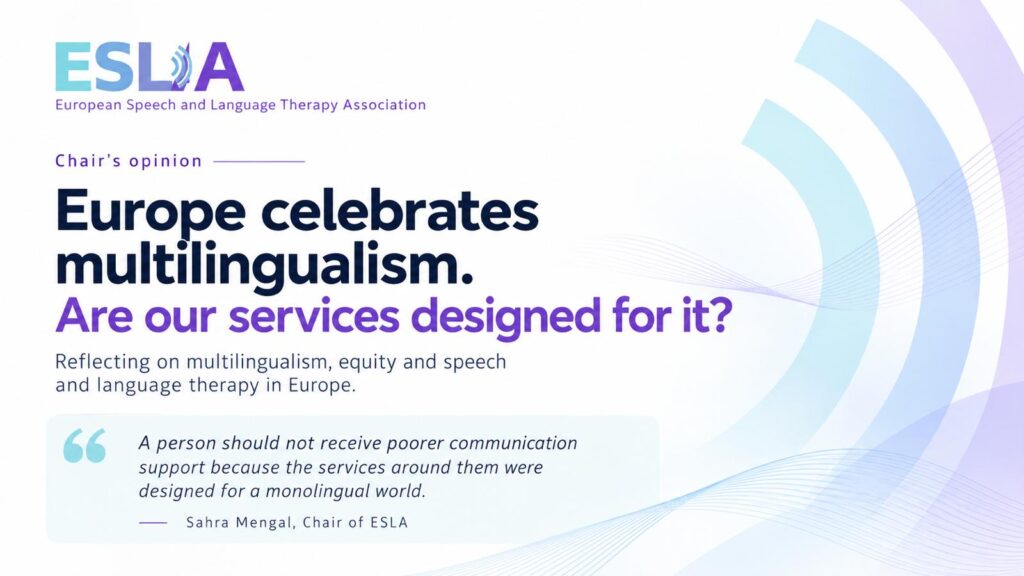
A person should not receive poorer communication support because the services around them were designed for a monolingual world.
The European Day of Languages is an important opportunity to celebrate Europe’s linguistic diversity.
But celebration alone is not enough.
The next step is to move from valuing linguistic diversity to designing services that genuinely reflect it — and to use our European networks to help make that change possible.
— Sahra Mengal, Chair of the European Speech and Language Therapy Association (ESLA)
Read the ESLA Position Paper on Multilingualism, Equity and Speech and Language Therapy in Europe: ESLA Multilingualism Position Paper