
Making our profession visible in wider European health discussions
by Sahra Mengal, ESLA Chair
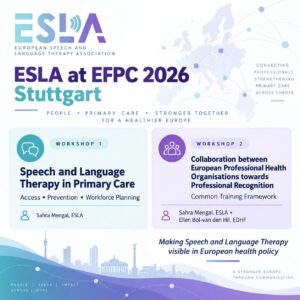
In September, I represented ESLA at the European Forum for Primary Care Conference in Stuttgart, where I contributed to two workshops that, although different in focus, were closely connected by one central question: how visible is Speech and Language Therapy in the European conversations that shape health systems and professional practice?
My first workshop focused on Speech and Language Therapy in Primary Care, with particular attention to policy, access, prevention and interprofessional workforce planning.
The aim was not simply to explain what SLTs do. The more important question was how communication, eating, drinking and swallowing needs are reflected in the way primary-care systems are designed.
Communication and swallowing needs are relevant across the life course, but they are not always visible in policy, care pathways or workforce planning. This can affect whether needs are recognised early, whether there is a clear route to appropriate expertise, and whether SLT capacity is considered when services are planned.
The policy discussion therefore focused on questions such as: How should primary-care systems recognise communication and swallowing needs? How can access to SLT expertise be built into care pathways? What role can SLT play in prevention? And how do we ensure that SLT is visible in workforce planning and in the data used to make decisions?
One of the important conclusions for me was that this is not about promoting one model of primary care across Europe.
Countries differ considerably in where Speech and Language Therapy sits within their systems. In some countries, SLTs are clearly embedded within health, primary or community care. In others, significant parts of the profession are organised through rehabilitation, education, municipal services or social care, and the connection to primary care may be less direct.
These differences matter for the profession.
They influence how people gain access to SLT services, which professionals are most likely to identify communication and swallowing needs, how referral pathways are organised, how SLTs collaborate with other professions, and whether the SLT workforce is visible in health-system data and planning.
They also influence how the profession is understood politically. Where SLTs are strongly embedded within health services, they may be more visible in discussions about prevention, rehabilitation and health workforce policy. Where SLTs are located mainly in education or other sectors, their contribution may be significant but less visible in health-policy discussions.
For ESLA, this means that our task is not to argue that every primary-care setting should have an SLT. Instead, we need to advocate for a common principle: communication and swallowing expertise should be considered when primary-care pathways, prevention strategies and workforce needs are designed.
Another important theme was data. Recorded demand is not always the same as actual need. If people are not recognised, never referred, or unable to access services, their needs may never appear in waiting lists, caseloads or workforce data. What remains invisible in the data can also remain invisible in policy and planning.
The discussion therefore reinforced the importance of linking SLT more clearly to broader European conversations about workforce planning, rehabilitation, prevention, integrated care and equitable access.
My second contribution was a joint workshop with Ellen Bol-van den Hil, President of the European Dental Hygienists Federation, focusing on collaboration between European professional health organisations and work towards professional recognition through a Common Training Framework.
This session raised a different set of questions, but the underlying issue was similar. Professional recognition, mobility and visibility across Europe depend on our ability to describe the profession clearly, understand differences between national systems, collect comparable information and collaborate with other European professional organisations.
Reflecting on both workshops, one message stays with me:
If Speech and Language Therapy is not visible in the discussions where European health systems, workforces and professional frameworks are being shaped, our contribution can easily be overlooked.
For ESLA, this means that our role is not only to represent SLTs within our own professional community. We also need to be present in wider European discussions on primary care, rehabilitation, workforce planning, professional recognition and integrated care.
The EFPC conference also gave me something to reflect on internally. We need to become better at learning systematically from our own member associations. Across Europe, there are already different models for how SLT connects with primary care, community services, rehabilitation, education and social care. ESLA should be better at identifying, comparing and sharing those models so that we can use the experience of our members more strategically in European policy work.
My hope is that this work can now continue through stronger collaboration with primary-care organisations such as EFPC, through dialogue with policymakers, and potentially through new joint working structures that bring communication and swallowing more clearly into the primary-care agenda.
For ESLA, this is ultimately about ensuring that our profession is not only present where SLTs already work, but also visible where decisions about the future of European care are being made.