
Language runs through almost every part of our lives: how we learn, connect with others, express ourselves and navigate the world around us. When language itself is difficult, the consequences can reach far beyond communication.
Developmental Language Disorder is common, yet it is still not consistently recognised or supported. Its impact differs from person to person and can change as the demands of life change. That is why DLD cannot be understood through a diagnosis or a test score alone. We also need to understand what language difficulties mean for a person’s ability to communicate, learn and participate in the situations that matter to them.
This year’s DLD Day theme, “Together for DLD”, captures something important. Improving the lives of people with DLD cannot be the responsibility of one profession, one service or one part of society. It requires people with DLD, families, speech and language therapists, educators, researchers, policymakers and other professionals to work together.
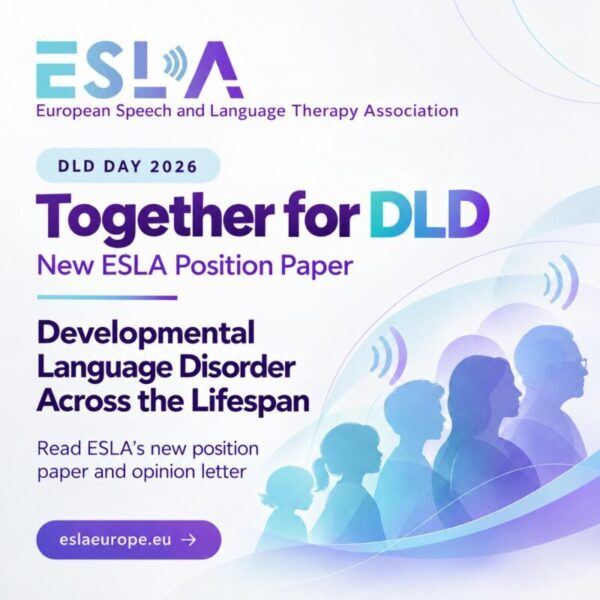
That idea is also at the heart of ESLA’s new position paper on Developmental Language Disorder across the lifespan.
The paper reflects a principle that I believe should guide our work across Europe: people with DLD should be able to access appropriate expertise and support when language difficulties create barriers in their lives.
That requires more than awareness.
It requires services that respond to people’s needs rather than relying on rigid age thresholds or single test scores. It requires access to specialist Speech and Language Therapy when individualised assessment or intervention is needed. And it requires pathways that allow people to return for support when their circumstances or communication demands change.
It also requires us to recognise the linguistic diversity of the people we serve.
Europe is multilingual. Multilingualism does not cause DLD, and speaking more than one language should never become a reason to delay assessment, overlook genuine language difficulties or reduce access to support. Assessment and intervention need to take account of the languages people actually use and the environments in which they communicate.
Working together also means looking beyond speech and language therapy services.
Education, healthcare, employment and public services all depend heavily on communication. When language demands are not recognised, people with DLD can encounter barriers that could otherwise be reduced. Building more accessible environments therefore requires collaboration across professions and sectors.
Research has an equally important role.
There is still much we need to understand: how DLD develops across the lifespan, what makes intervention effective, how multilingual populations can be better represented in research, and how services are organised across European countries. We also need to listen more carefully to people with DLD themselves when deciding what research should focus on and which outcomes matter most in their lives.
For ESLA, “Together for DLD” captures the importance of bringing people together around a shared commitment to better recognition, support and opportunities for people with DLD. It means building stronger connections between people with lived experience, families, clinicians, researchers, services and policymakers throughout the year.
It should also mean stronger cooperation across Europe. We need a clearer picture of how DLD is identified and supported in different countries, where the gaps remain and what we can learn from one another. That knowledge can give us a stronger foundation for advocacy, service development and research.
This collaborative approach is already reflected in ESLA’s work. Our Expert Group on DLD in Adults brings together researchers from different European countries to strengthen knowledge about DLD beyond childhood and to explore how research and services can better respond to the needs of adults with DLD.
As ESLA Chair, I am closely involved in supporting the group and helping to connect its work with ESLA’s wider priorities. I am excited to see how this collaboration can strengthen the European perspective on adult DLD, bring research and practice closer together, and help move this area forward.
Awareness matters. But awareness should lead somewhere.
It should lead to better recognition, more equitable access to expertise, services that respond when needs change, and research that addresses the questions that matter in people’s lives.
As Chair of ESLA, I hope our new position paper contributes to that next step.
Together, we can move from recognising DLD to creating the conditions in which people with DLD can participate, communicate and thrive throughout their lives.
Sahra Mengal
Chair, European Speech and Language Therapy Association (ESLA)