
Multilingualism, Equity and Speech and Language Therapy in Europe
A European position on communication access, participation and equitable speech and language therapy services across the lifespan
Executive Summary
Multilingualism is a defining feature and a collective asset of Europe. The European Union has 24 official languages and more than 60 regional and minority languages, alongside dialects, Indigenous, heritage, migrant and signed languages. In the 2024 Eurobarometer, 59% of Europeans reported that they could hold a conversation in at least one foreign language and 28% in at least two [1].
This position paper was developed by the European Speech and Language Therapy Association (ESLA), with contributions from the ESLA Expert Group on Multilingualism through expert discussion and input throughout the development of the paper. It is intended for Speech and Language Therapists, service leaders, educators, researchers, professional bodies and policy makers at national and European level.
The paper addresses multilingual people across the lifespan who may need support in relation to speech,
language, communication and/or swallowing disorders.
ESLA emphasises that multilingualism is not a disorder and should not be treated as a clinical problem in itself.
Equitable services must take account of the person’s full linguistic, cultural and communicative repertoire,
abilities and needs.
ESLA calls for:
• recognition of multilingualism as a typical and valuable feature of human communication,
and explicit attention to linguistic equity in European and national policy;
• equitable access to high-quality speech and language therapy services across the lifespan;
• assessment, diagnosis and intervention that consider all relevant languages and
communication contexts, with access to trained interpreters and cultural mediators where
needed;
• stronger professional education and continuing professional development in multilingual
and culturally responsive practice;
• collaboration with families, caregivers, educators, health and social care professionals,
interpreters and communities; and
• investment in data, research, multilingual resources, implementation and a more
multilingual and culturally diverse workforce.
ESLA calls for coordinated European action across health, education, rehabilitation and social care
to strengthen equity, quality and professional competence in services for multilingual people.
The position paper at a glance
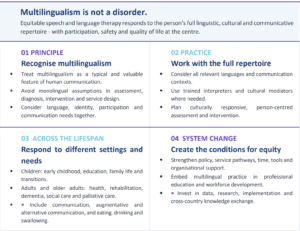
ESLA calls for coordinated European action across health,
education, rehabilitation and social care.
Contents
Introduction: Definitions, Background and Scope
Why This Matters for European and National Policy
Monolingual Bias
Linguistic and Cultural Diversity
Importance of Equity in Service Delivery for Multilingual People
Principles for High-Quality Professional Education and Continuing Development in Speech and Language
Therapy
Multilingualism in Children’s Services, Schools and Education Settings
Multilingualism in Adult Health, Rehabilitation and Social Care Settings
Policy and Practice Recommendations
Future Recommendations, Including Research Needs
Conclusion
ESLA Expert Group on Multilingualism
Selected References and Evidence Base
Introduction: Definitions, Background and Scope
In this paper, multilingualism refers to the use, understanding or exposure to more than one language or dialect in everyday life.
Different languages may be used at home, in education, at work, in healthcare, in social care, in the community or in digital environments.
The term includes spoken and signed languages, Indigenous, regional and minority languages, heritage and migrant languages, and languages acquired later in life.
Europe’s linguistic diversity is substantial: the European Union recognises 24 official languages and more than 60 regional and minority languages, while migration and mobility add many further languages to local communities.
Recent European survey data also show that multilingual language use and language learning are widespread [1]. Multilingualism is understood broadly. A multilingual person may not have equal proficiency in all languages and may use different languages with different people and for different purposes. Understanding, speaking, signing, reading and writing may also vary across languages.
Language use, dominance and proficiency can change over time through education, migration, social networks, language attrition, illness, neurological injury or ageing.
Throughout this paper, speech and language therapy refers to the professional field addressing speech, language, communication, voice, fluency, augmentative and alternative communication, and eating, drinking and swallowing needs across the lifespan.
The term Speech and Language Therapist refers to a professional working within this field. Professional titles and scopes of practice vary across European countries.
This position paper concerns multilingual people who may need speech and language therapy services across the lifespan. This includes children with developmental speech, language and communication needs, adults with acquired communication disorders, and people with lifelong disabilities or swallowing disorders. It also includes families, caregivers and communication partners who need information and support in languages they understand.
The paper covers speech, language, communication and swallowing disorders, including but not limited to:
developmental language disorder;
• speech sound disorders;
• stuttering and other fluency disorders;
• voice disorders;
• aphasia;
• dysarthria;
• apraxia of speech;
• cognitive-communication disorders;
• social communication difficulties;
• communication needs associated with autism, intellectual disability, dementia, brain injury or progressive
neurological conditions;
• literacy and learning difficulties where these are associated with speech, language and communication needs;
• complex communication needs and augmentative and alternative communication; and
• eating, drinking and swallowing disorders.
The central argument is that multilingual people should not be disadvantaged by speech and language therapy systems built around monolingual assumptions. These assumptions may be visible when people are compared only with monolingual norms, assessed in one language, offered services only in the societal language, or advised to reduce or stop use of home languages. Assessment, diagnosis, intervention, counselling and service delivery should instead take account of the person’s full linguistic, cultural and communicative history and profile [2–4].
This is not only a matter of individual professional practice. It is also a matter of policy, service design, workforce development, professional education, research, regulation and resource allocation.
Why This Matters for European and National Policy
Multilingualism is central to Europe’s identity, values and social reality. European societies are linguistically
diverse, and this diversity is reflected in families, schools, workplaces, healthcare systems, rehabilitation services, care homes and communities.
Speech, language, communication and swallowing disorders affect participation, education, employment, health, wellbeing, safety and quality of life. When services are not equipped to work effectively with multilingual people, inequalities can arise across the lifespan.
For children and young people, multilingualism intersects with early development, inclusive education, special educational needs, family support and participation in school life. Children may be misidentified as having a speech or language disorder when differences reflect their exposure to the language of schooling. Conversely, genuine speech, language and communication needs may be missed when difficulties are attributed to multilingualism or second-language learning [2,3].
For adults, multilingualism is highly relevant in healthcare and rehabilitation. Aphasia, dementia, dysarthria, voice disorders and cognitive-communication disorders may present differently across languages. Assessment in only one language can therefore give an incomplete picture of abilities and needs.
Intervention planning should consider language history and current use, as well as identity, relationships, work, care and participation. Evidence from bilingual aphasia shows that treatment gains and cross-language generalisation vary between individuals, reinforcing the need for person-specific planning [9].
For people with eating, drinking and swallowing disorders, equitable care requires clear communication about assessment findings, risks, recommendations, consent, mealtime strategies and quality of life. Cultural beliefs and practices can shape expectations and decision-making, including beliefs about disability, development, health, family roles, communication and professional authority. These considerations are relevant across speech and language therapy, not only in swallowing care.
There are wider societal consequences. Equitable and timely speech and language therapy can support
participation, education, employment, safety and independent living, while reducing avoidable delays, repeated assessment, inappropriate referral and unsuitable intervention. Economic evidence specific to multilingual speech and language therapy remains limited. Broader national cost-benefit work nevertheless indicates educational, social and economic benefits from timely speech and language intervention [12].
Delayed or inaccurate identification may widen inequalities and create additional costs for health, education and social systems.
This position paper is relevant to policy because equitable speech and language therapy provision is connected to:
• inclusive education;
• access to healthcare;
• disability rights;
• ageing and dementia care;
• rehabilitation after stroke, cancer, brain injury and neurological disease;
• migrant and refugee health;
• patient safety;
• informed consent and shared decision-making;
• workforce development;
• social participation;
• equity and non-discrimination; and
• culturally responsive practice.
Monolingual Bias
Monolingual bias is the assumption that monolingual development, communication and assessment are the
default or preferred standard.
In speech and language therapy, it may be reflected in assessment tools, diagnostic criteria, intervention planning, service pathways, professional education, research, funding and policy.
Monolingual bias can lead to:
• assessment of multilingual people in only one language;
• inappropriate comparison with monolingual norms;
• over-identification of disorder when differences are instead attributable to patterns, quantity or quality of
language exposure;
• under-identification of disorder when difficulties are wrongly attributed to multilingualism or second-language
learning;
• advice to families to stop or reduce use of home languages;
• service provision only in the majority or societal language;
• intervention targeting only the majority language without considering the person’s needs and goals;
• failure to consider language use in work, family, education, healthcare or care settings;
• limited access to trained interpreters and cultural mediators;
• lack of culturally responsive counselling and shared decision-making;
• funding, insurance or reimbursement criteria that exclude or delay access when communication difficulties are assumed to be explained by multilingualism, second-language learning or immersion education;
• swallowing recommendations that do not take account of customary foods, textures, flavours, religious practices or mealtime routines; and
• reduced participation in decisions about care and intervention.
Monolingual bias affects people across the lifespan. A child may be assessed only in the school language. An adult with aphasia may receive therapy only in the majority language even when another language is central to family communication. A person with dementia may increasingly use an earlier-acquired language while services continue to use only the societal language. Swallowing recommendations may also fail to reflect a person’s usual diet or cultural practices.
Addressing monolingual bias requires structural as well as individual change. Speech and Language Therapists need time, appropriate tools, supervision, interpreter access, culturally responsive resources and organisational support. Policy makers, commissioners and service leaders should also ensure that funding models, referral criteria, assessment procedures, reimbursement arrangements and workforce planning do not reproduce monolingual bias.
Linguistic and Cultural Diversity
Speech and language therapy is concerned not only with impairment, but also with communication, participation, identity, safety and quality of life. Linguistic and cultural diversity is therefore central to the profession.
Culturally responsive practice should be accompanied by cultural humility: an ongoing commitment to selfreflection, learning from people and communities, and recognising power differences [8].
It also requires avoiding the assumption that a professional can become fully “competent” in another person’s culture. Cultural humility is a lifelong professional stance rather than a finite body of knowledge.
A multilingual person’s communication profile may vary depending on:
• language exposure, amount and quality of input, and patterns of use;
• age and context of acquisition;
• language dominance, proficiency and language attrition;
• literacy and educational history;
• migration history;
• family and community language practices;
• communication partners and opportunities to use each language;
• language mixing, code-switching and translanguaging practices;
• emotional, relational and identity associations with different languages;
• health condition and neurological status;
• cognitive load and fatigue;
• setting and purpose of communication.
Language mixing and code-switching are common features of multilingual communication and should not in
themselves be treated as signs of disorder [7].
In education, translanguaging can allow learners to draw on their full linguistic repertoire to understand, communicate, participate and demonstrate knowledge [13]. Professionals should distinguish these multilingual practices from clinically meaningful difficulties.
For children, different languages may be used at home, in early childhood settings, in school and with peers. For adults, different languages may be used with partners, children, parents, colleagues, health professionals or caregivers. For older adults, language use may shift with ageing, illness, dementia or changes in living situation.
Culturally responsive speech and language therapy requires professionals and services to understand the person’s communication environment. This includes asking:
• Which languages does the person understand, speak, sign, read or write?
• Which languages are used with family, friends, professionals and caregivers?
• Which languages are needed for daily life, participation, safety and identity?
• Are concerns present in one language, across several languages, or in particular contexts?
• How does the person mix, switch or move between languages in everyday communication?
• What are the person’s and family’s goals and priorities?
• What cultural beliefs and practices may influence communication, disability, health, eating, drinking, care or intervention?
• What support is needed to ensure informed consent and shared decision-making?
For swallowing disorders, linguistic and cultural diversity may be particularly relevant when discussing food
textures, mealtime routines, religious practices, family roles, risk, comfort feeding, palliative care and quality of life.
Speech and Language Therapists should treat multilingualism and cultural diversity as integral to assessment and intervention, not as additional complications. Evidence from bilingual intervention research indicates that supporting more than one language can be clinically meaningful [5].
Majority-language-only intervention should therefore not be assumed to meet all needs. Service providers and policy makers must support equitable multilingual practice with appropriate systems, time, training and resources.
Importance of Equity in Service Delivery for Multilingual People
Equity means providing speech and language therapy services that are appropriate to multilingual people’s needs, circumstances and communication contexts. Offering the same service to everyone is not equitable if that service is designed around monolingual assumptions.
Equitable service delivery requires:
• accessible referral pathways;
• timely identification of speech, language, communication and swallowing needs;
• assessment that considers all relevant languages and communication contexts using appropriate tools and
methods;
• access to trained interpreters and cultural mediators;
• clear information in languages that people and families understand;
• culturally responsive intervention planning;
• involvement of families, caregivers and communication partners;
• appropriate support for decision-making and consent;
• consideration of the person’s own goals and priorities; and
• monitoring of access, quality and outcomes for multilingual service users.
Equity applies across all areas of speech and language therapy. In child services, uncertainty about multilingualassessment should not delay access.
In adult neurorehabilitation, communication needs should be considered across relevant languages. In swallowing services, people and families need to understand recommendations and discuss how they fit cultural and personal preferences. In augmentative and alternative communication, system and vocabulary choices should reflect multilingual communication needs.
Multilingual people may experience both over-identification and under-identification. Typical multilingual
development can be misunderstood as disorder, while genuine difficulties may be attributed to limited proficiency in the societal language. This can lead to inappropriate referral or diagnosis, delayed assessment, or premature discharge. Both outcomes are inequitable.
Principles for High-Quality Professional Education and Continuing Development in Speech and Language Therapy
Speech and language therapy education must prepare graduates to work competently and ethically with
multilingual and culturally diverse individuals and communities. Multilingualism and culturally responsive practice should not be treated as specialist or optional topics. They should be embedded throughout pre-registration education and continuing professional development.
Core professional education and continuing development should include:
• typical multilingual development across the lifespan and the distinction between language difference and
disorder;
• cultural humility, culturally responsive practice and reflection on professional power and bias;
• language-specific and cross-linguistic influences on speech, language, communication, literacy, learning and
cognition, including phonological inventories, morphosyntax, word order, writing systems and cross-linguistic
transfer;
• assessment approaches that combine multiple sources of evidence and avoid inappropriate reliance on
monolingual norms;
• interpreter-mediated and culturally mediated practice;
• multilingual intervention planning across child and adult communication disorders, swallowing and augmentative
and alternative communication;
• ethical, legal and service-level issues, including informed consent, data protection, access and equity;
• supervised opportunities to work with linguistically and culturally diverse people and communities; and
• lifelong learning and access to specialist consultation when a professional’s own knowledge or language skills are insufficient.
Professional education should also recognise multilingualism as an asset within the workforce. Education
institutions and employers should recruit, support and retain multilingual and culturally diverse students and professionals. Responsibility for equitable multilingual care, however, must remain shared across the profession rather than resting only with multilingual staff.
Multilingualism in Children’s Services, Schools and Education Settings
Service models for children vary considerably across Europe. Speech and language therapy may be delivered in schools, early childhood services, hospitals, health centres, community services, specialist centres or private practice.
This paper therefore focuses on principles that apply across settings rather than assuming one service
model.
Education and early childhood settings are important communication environments. Multilingual children may be learning the language of schooling while also developing or maintaining other languages used at home and in their communities. Where there are concerns about speech, language or communication, Speech and Language Therapists contribute through differential assessment, intervention, consultation with educators, collaboration with families and support for participation.
Good practice in child and education contexts includes:
• recognizing children’s full linguistic repertoires and valuing home and community languages;
• distinguishing typical multilingual development and second-language learning from speech, language and
communication disorders;
• using assessment approaches that draw on developmental history, language exposure, progress across languages,
family concerns, educator observations, functional participation and appropriate direct assessment [2–4];
• considering cross-linguistic transfer and language-specific features when interpreting performance, so that
expected multilingual patterns are not misread as disorder;
• supporting children with developmental language disorder and other communication needs in multilingual
contexts;
• recognizing language mixing, code-switching and translanguaging as potentially functional resources rather than automatically treating them as errors [7,13];
• advising on inclusive communication and classroom strategies within the speech and language therapy scope of practice;
• supporting transitions between early childhood settings, school stages, health and specialist services; and
• promoting collaboration between families, education, health and other relevant services.
Schools should not use multilingualism as an explanation for all educational or communication difficulties. Equally, Speech and Language Therapists should not be responsible for general second-language teaching. Their distinctive contribution is to help distinguish multilingual language learning from difficulties that require broader educational language support or specialist speech, language or communication assessment and intervention.
For children with complex communication needs, augmentative and alternative communication systems and
communication supports should reflect the child’s multilingual environment wherever possible. Children should not be limited to communicating in only one language when family and community life requires more than one.
For policy makers, multilingualism should be integrated into inclusive education policy, early identification systems, service pathways and professional development for education and health staff. Implementation should allow flexibility for different national models of speech and language therapy provision.
Multilingualism in Adult Health, Rehabilitation and Social Care Settings
Multilingualism is highly relevant in adult speech and language therapy. Adults may need services after stroke, traumatic brain injury, neurological disease, cancer, dementia, voice difficulties or other conditions affecting communication or swallowing.
In adult services, multilingualism should be considered in:
• aphasia assessment and intervention;
• motor speech disorders;
• cognitive-communication disorders;
• dementia care;
• voice therapy;
• head and neck cancer rehabilitation;
• augmentative and alternative communication assessment and intervention;
• eating, drinking and swallowing assessment and management;
• palliative and end-of-life care; and
• counselling and communication partner training.
A multilingual adult’s languages may have different emotional, relational, functional and social importance. One language may be needed for work, another for healthcare or family relationships, and another may be central to identity.
After neurological injury or in dementia, languages may be affected differently. Patterns of recovery and
cross-language generalisation also vary between individuals [9].
Speech and Language Therapists should therefore consider:
• pre-morbid language history, including age and context of acquisition;
• language proficiency and dominance before and after onset;
• current language use, switching and code-switching patterns, and any evidence of language attrition;
• the emotional, relational and identity value of each language;
• family and community communication needs;
• literacy across languages;
• cultural beliefs about illness, disability and care;
• the person’s goals and which languages should be prioritised for participation, safety and quality of life;
• the possibility, but not the assumption, of cross-language generalisation following therapy;
• communication partner training in languages used by family members, caregivers and key communication
partners; and
• the need for interpreter-supported assessment, intervention and counselling.
In swallowing care, multilingual adults and their families must be able to understand assessment findings, risks, recommendations and choices. Communication must support informed consent, shared decision-making and dignity.
For service leaders and policy makers, multilingualism should therefore be addressed in rehabilitation pathways, dementia services, stroke care, cancer care, palliative care, disability services and long-term care.
Policy and Practice Recommendations
ESLA proposes the following recommendations, informed by the work of its expert group on multilingualism and the evidence base summarised in this paper.
For European and National Policy Makers:
Policy makers should recognise multilingualism as a key dimension of health equity, inclusive education, disability rights, cultural participation and social participation.
ESLA recommends that European and national policy makers:
• ensure that policies on health, education, rehabilitation, ageing, migration, disability and social inclusion explicitly address access to speech and language therapy for multilingual people;
• recognize speech, language, communication and swallowing needs as relevant to participation, safety, education, employment, care and quality of life;
• fund access to trained interpreters and cultural mediators in health, education, rehabilitation and social care settings;
• support the development, validation and implementation of multilingual assessment tools, clinical guidance and accessible resources;
• invest in cross-country research on multilingual speech and language therapy provision, access, outcomes,
inequalities and implementation;
• support proportionate data collection, where feasible, on referral, waiting times, assessment, diagnosis, duration of intervention, discharge and outcomes for multilingual service users;
• include multilingual people, families, caregivers and communities as partners in policy development;
• support secure European professional networks or digital platforms through which Speech and Language
Therapists can obtain language-specific expertise, consultation and case discussion, in accordance with
professional standards and data-protection requirements;
• explore lawful and clinically appropriate mechanisms for cross-border access to language-matched speech and language therapy expertise for specific needs, particularly where relevant expertise in less widely used languages is not available locally; and
• support strategies to recruit, educate and retain a multilingual and culturally diverse speech and language therapy workforce.
For Service Providers and Employers
Service providers and employers should ensure that speech and language therapy services have the structures, time and resources needed to provide equitable care.
ESLA recommends that service providers and employers:
ensure access to trained interpreters and cultural mediators where needed;
• provide sufficient time for multilingual case history-taking, assessment, counselling, collaboration and interpretermediated work;
• develop referral and assessment pathways that reduce the risk of both over-identification and underidentification;
• monitor whether multilingual people experience unequal access, longer waiting times, different durations of
intervention or different outcomes;
• support Speech and Language Therapists with supervision, continuing professional development, specialist
consultation and appropriate resources;
• promote collaboration between Speech and Language Therapists, educators, health professionals, social care staff, interpreters and community organisations;
• ensure that information about services, rights, consent and recommendations is accessible to multilingual people and families; and
• actively recruit, support and retain multilingual and culturally diverse Speech and Language Therapists and
recognise language skills as a professional resource.
For Speech and Language Therapy Education Institutions and Professional Bodies
Speech and language therapy education institutions and professional bodies should ensure that multilingualism and culturally responsive practice are embedded as core areas of professional competence.
ESLA recommends that education institutions and professional bodies:
• embed multilingualism and cultural humility throughout speech and language therapy curricula rather than
confining them to optional modules;
• include multilingual considerations across child, adult, communication, voice, fluency, augmentative
communication and swallowing teaching;
• provide training in interpreter-mediated and culturally mediated practice;
• provide training in culturally responsive assessment, diagnosis, intervention and counselling;
• teach language-specific and cross-linguistic influences on speech, language, communication, literacy, learning and
cognition;
• develop continuing professional development and lifelong learning opportunities in multilingual speech and
language therapy practice;
• support recruitment and retention of multilingual and culturally diverse students and professionals;
• support the development of European guidance, shared resources and secure networks for professional
consultation; and
• promote research and knowledge exchange across countries.
For Speech and Language Therapists
Speech and Language Therapists should provide evidence-informed, culturally responsive and person-centred care for multilingual people and should maintain competence through lifelong learning.
ESLA recommends that Speech and Language Therapists:
• consider the person’s full linguistic and cultural repertoire in assessment, diagnosis and intervention;
• consider how language-specific properties may influence assessment performance, error patterns, learning
trajectories and everyday communication, rather than assuming that all languages place identical demands on speech, language, memory, literacy or learning [10];
• avoid relying solely on monolingual norms or single-language assessment;
• use multiple sources of evidence, including developmental and case history, observation, functional
communication, family and caregiver perspectives, appropriately selected tools and dynamic assessment where relevant [3,4];
• work collaboratively with interpreters, families, caregivers and other professionals;
• support communication in the languages needed for effective communication, participation, identity, care and quality of life;
• consider cultural and linguistic factors in eating, drinking and swallowing management and communication about risk;
• practise cultural humility through ongoing reflection on assumptions, bias and power [8];
• seek further learning, supervision or specialist consultation when their knowledge or language skills are
insufficient; and
• advocate for equitable service provision and for systems that do not reproduce monolingual bias.
Future Recommendations, Including Research Needs
Further work is needed to strengthen multilingual speech and language therapy practice across Europe. Priority areas for future research and development include:
1. Mapping speech and language therapy service provision across Europe. Existing international practitioner surveys provide an important starting point [6]. Updated and systematic comparative data are needed on how multilingual children and adults access speech and language therapy across countries, service models, age groups and clinical areas.
2. Assessment tools and clinical frameworks. More work is needed to develop, validate and implement
assessment approaches that are appropriate for multilingual people across clinical areas, including methods that can be used when language-matched standardised tools are unavailable.
3. Developmental speech and language disorders. Research should continue to improve understanding of multilingual development and developmental language disorder, speech sound disorders, stuttering and other childhood communication needs, including how exposure, cross-linguistic transfer and educational context influence presentation.
4. Acquired communication disorders. More evidence is needed on multilingual aphasia, dysarthria, apraxia, cognitive-communication disorders and dementia-related communication changes, including recovery across languages and factors influencing treatment generalisation [9].
5. Eating, drinking and swallowing and multilingual care. Research should examine how linguistic and cultural factors influence swallowing assessment, recommendations, adherence, shared decision-making, risk communication and quality of life.
6. Augmentative and alternative communication and multilingual communication. More guidance and research are needed on multilingual communication systems, vocabulary selection, language access, symbol use and communication partner support.
7. Interpreter-mediated speech and language therapy practice. Research should explore effective and safe models for working with interpreters and cultural mediators in assessment, intervention and counselling, including training needs for both Speech and Language Therapists and interpreters.
8. Professional education and workforce development. Studies are needed on how speech and language therapy students and practising professionals develop competence in multilingual practice, cultural responsiveness and cultural humility. Research should also examine how services can recruit and retain a more multilingual workforce.
9. Cross-linguistic and language-specific influences. Further research is needed on how language-specific properties influence speech, language, communication, literacy, learning and cognitive processing. Relevant features include phonological contrasts, morphosyntax, word order, cross-linguistic transfer, writing systems, number-word structures and relationships between language and memory, attention and learning [10]. This work should inform assessment, differential diagnosis, intervention planning and professional education without promoting deterministic or deficit-based interpretations of multilingualism.
10. Service-user, family and community partnership. Multilingual people, families and caregivers should not only be studied as participants but recognised as partners in the production of knowledge, service development and policy change. Participatory and co-production approaches can help identify and test solutions to challenges in real-world speech and language therapy practice [11].
11. Implementation in real-world services. Research should move beyond describing barriers and focus on how equitable multilingual practice can be implemented and sustained in services with limited resources, differing regulatory systems and uneven access to language-matched professionals.
12. Health-economic and societal impact. More evidence is needed on the short- and long-term economic, educational, health and social consequences of equitable versus inequitable multilingual speech and language therapy provision. This would strengthen the case for investment and help policy makers understand the costs of delayed identification, misdiagnosis and inadequate access.
Conclusion
Multilingualism is a central and valuable part of communication in Europe. It is relevant to speech and language therapy across the lifespan and across all areas of practice, including speech, language, communication, voice, fluency, augmentative communication and swallowing.
ESLA recognises that multilingualism is not a disorder and should not be treated as a clinical problem in itself. Multilingual people who have speech, language, communication or swallowing disorders require services that acknowledge and respond to their linguistic and cultural realities.
Equitable multilingual speech and language therapy requires relevant knowledge, professional competence,
cultural humility, appropriate resources, access to trained interpreters and cultural mediators, culturally
responsive practice, interprofessional collaboration, multilingual workforce development and supportive policy frameworks.
This position paper calls for a European commitment to high-quality, evidence-informed and equitable speech and language therapy for multilingual people, families and communities. Achieving this requires coordinated action from policy makers, service providers, education institutions, professional bodies, researchers, people who use services and Speech and Language Therapists.
ESLA Expert Group on Multilingualism
- Sahra Mengal — Denmark
Spyros Koutras — Greece
Ciara O’Toole — Ireland
Monica Norvik — Norway
Sophie Gillet — Belgium
Pauline van der Straten Waillet — Belgium
Glenn Aerts — Belgium
Jovana Janjic — Serbia
Theodora Papastefanou — Cyprus
Rafal Mlynski — Poland
Sione Twilt — Netherlands
Simone Giacometti — Italy
Selected References and Evidence Base
The following references are selected to support key positions and reviewer recommendations in this paper; they are not intended to be an exhaustive review of the multilingual speech and language therapy literature.
[1] European Commission & Verian. (2024). Europeans and their languages. Publications Office of the European Union. https://doi.org/10.2766/28257
[2] Kohnert, K. (2010). Bilingual children with primary language impairment: Issues, evidence and implications for clinical actions. Journal of Communication Disorders, 43(6), 456–473.
https://doi.org/10.1016/j.jcomdis.2010.02.002
[3] Peña, E. D., Gillam, R. B., & Bedore, L. M. (2014). Dynamic assessment of narrative ability in English accurately identifies language impairment in English language learners. Journal of Speech, Language, and Hearing Research, 57(6), 2208–2220. https://doi.org/10.1044/2014_JSLHR-L-13-0151
[4] McLeod, S., Verdon, S., & The International Expert Panel on Multilingual Children’s Speech. (2017). Tutorial: Speech assessment for multilingual children who do not speak the same language(s) as the speech-language pathologist. American Journal of Speech-Language Pathology, 26(3), 691–708. https://doi.org/10.1044/2017_AJSLP-15-0161
[5] Restrepo, M. A., Morgan, G. P., & Thompson, M. S. (2013). The efficacy of a vocabulary intervention for duallanguage learners with language impairment. Journal of Speech, Language, and Hearing Research, 56(2), 748–765. https://doi.org/10.1044/1092-4388(2012/11-0173)
[6] Stankova, M., Rodríguez-Ortiz, I. R., Matić, A., Levickis, P., Lyons, R., Messarra, C., et al. (2021). Cultural and linguistic practice with children with developmental language disorder: Findings from an international practitioner survey. Folia Phoniatrica et Logopaedica, 73(6), 465–477. https://doi.org/10.1159/000511903
[7] Gross, M. C., & Castilla-Earls, A. (2023). Code-switching during narratives by bilingual children with and without developmental language disorder. Language, Speech, and Hearing Services in Schools, 54(3), 996–1019. https://doi.org/10.1044/2023_LSHSS-22-00149
[8] Tervalon, M., & Murray-García, J. (1998). Cultural humility versus cultural competence: A critical distinction in defining physician training outcomes in multicultural education. Journal of Health Care for the Poor and Underserved, 9(2), 117–125. https://doi.org/10.1353/hpu.2010.0233
[9] Kiran, S., Sandberg, C., Gray, T., Ascenso, E., & Kester, E. (2013). Rehabilitation in bilingual aphasia: Evidence for within- and between-language generalization. American Journal of Speech-Language Pathology, 22(2), S298–S309. https://doi.org/10.1044/1058-0360(2013/12-0085)
[10] Amici, F., Sánchez-Amaro, A., Sebastián-Enesco, C., Cacchione, T., Allritz, M., Salazar-Bonet, J., & Rossano, F.
(2019). The word order of languages predicts native speakers’ working memory. Scientific Reports, 9, 1124.
https://doi.org/10.1038/s41598-018-37654-9
[11] Pomey, M.-P., Flora, L., Karazivan, P., Dumez, V., Lebel, P., Vanier, M.-C., Débarges, B., Clavel, N., & Jouet, E. (2015). The Montreal model: The challenges of a partnership relationship between patients and healthcare professionals. Santé Publique, HS, 41–50. https://doi.org/10.3917/spub.150.0041
[12] Berden, C., & Kok, L. (2012). De waarde van logopedie: De kosten en baten van logopedie bij kinderen met spraak-/taalstoornissen (SEO Report 2012-69). SEO Economisch Onderzoek.
[13] García, O., & Wei, L. (2015). Translanguaging, bilingualism, and bilingual education. In W. E. Wright, S. Boun, & O. García (Eds.), The Handbook of Bilingual and Multilingual Education. Wiley.
https://doi.org/10.1002/9781118533406.ch13